
Focus & energy

How to fit exercise into a busy week

Not a training plan: a planning method. Find the gaps your week actually has, protect two or three of them, size the sessions to the week you are having, and know in advance what happens when you miss.

Aleem O'BalogunBy Aleem O'Balogun|Updated |7 min read

The short answer

To fit exercise into a busy week, stop hunting for the perfect time and protect two or three realistic training slots around your fixed commitments, sized to the week you are actually having. A session with a named day and time survives a full week; a session waiting for a free hour does not, because busy weeks do not have free hours, only defended ones.

Steps

  1. 1

    Write down the wall first

    List the commitments that genuinely cannot move: work blocks, school runs, the evenings already spoken for, the sleep you intend to keep. Training fits around this wall, the same wall the full weekly method starts from, so you need to see it before you place anything. Most abandoned plans were built on hours that were never really there.

  2. 2

    Find the gaps that survive contact

    Look for the openings that exist in practice, not on paper: the lunch hour that is actually yours, the early evening before home takes over, the weekend morning. Be suspicious of any gap that requires you to become a different person to use it; the 6am slot only counts if you are already a 6am person.

  3. 3

    Protect two or three, not seven

    Give each chosen session a day, a time and a duration in your calendar, and defend it the way you would an appointment with another person. Two sessions that happen beat five that were hoped for, and a small number of protected slots is far easier to hold than a plan spread thinly across every day.

  4. 4

    Size the sessions to the week you are having

    Before placing anything, look at what this week actually is. A heavy week gets fewer, easier sessions, placed away from its hardest days; a lighter week can carry the harder work. Deciding this before the week starts beats renegotiating with yourself on Wednesday, when the deadline wins every time.

Why “I will fit it in” fails by Tuesday

Training loses to busy weeks for a structural reason, not a motivational one. Work arrives with scaffolding: meetings, deadlines, other people holding you to things. Exercise has none of that. No slot, no deadline, nobody waiting, so it becomes the flexible element in the week, and the flexible element absorbs every overrun. By Tuesday the week is renegotiating your intentions for you, and the week is the better negotiator.

The fix is embarrassingly specific. Research suggests that naming the time is most of the battle: in a 2002 study in the British Journal of Health Psychology, people who wrote down exactly when and where they would exercise trained at more than double the rate of those who were merely motivated to; 91 percent exercised the following week, against under 40 percent in both other groups. In practice, this means the useful question is never “how do I find more motivation?” It is “which day, which time, how long?”
How much is actually enough for a busy week

It helps to know what you are aiming at, because most busy people aim at an imagined seven-day athlete and abandon the whole idea the first time a real week disagrees. The NHS guideline for adults is at least 150 minutes of moderate activity a week, or 75 of vigorous, plus strength work on two days. As planning arithmetic, that is three 50-minute sessions, or four of 35 to 40 minutes. Two or three protected slots gets you most of the way there, most weeks.

The same guidance is just as useful at the floor: even once or twice a week can reduce the risk of heart disease and stroke. On the weeks that collapse, one honest session is not a failed week. It is the guideline's own minimum, kept.

One deadline week, placed by hand

Here is the method run once, by someone real enough to borrow: a designer, studio days that run nine to five, a client deadline on Wednesday evening, away visiting family from Friday night, and a half marathon eight weeks out that wants four runs this week.

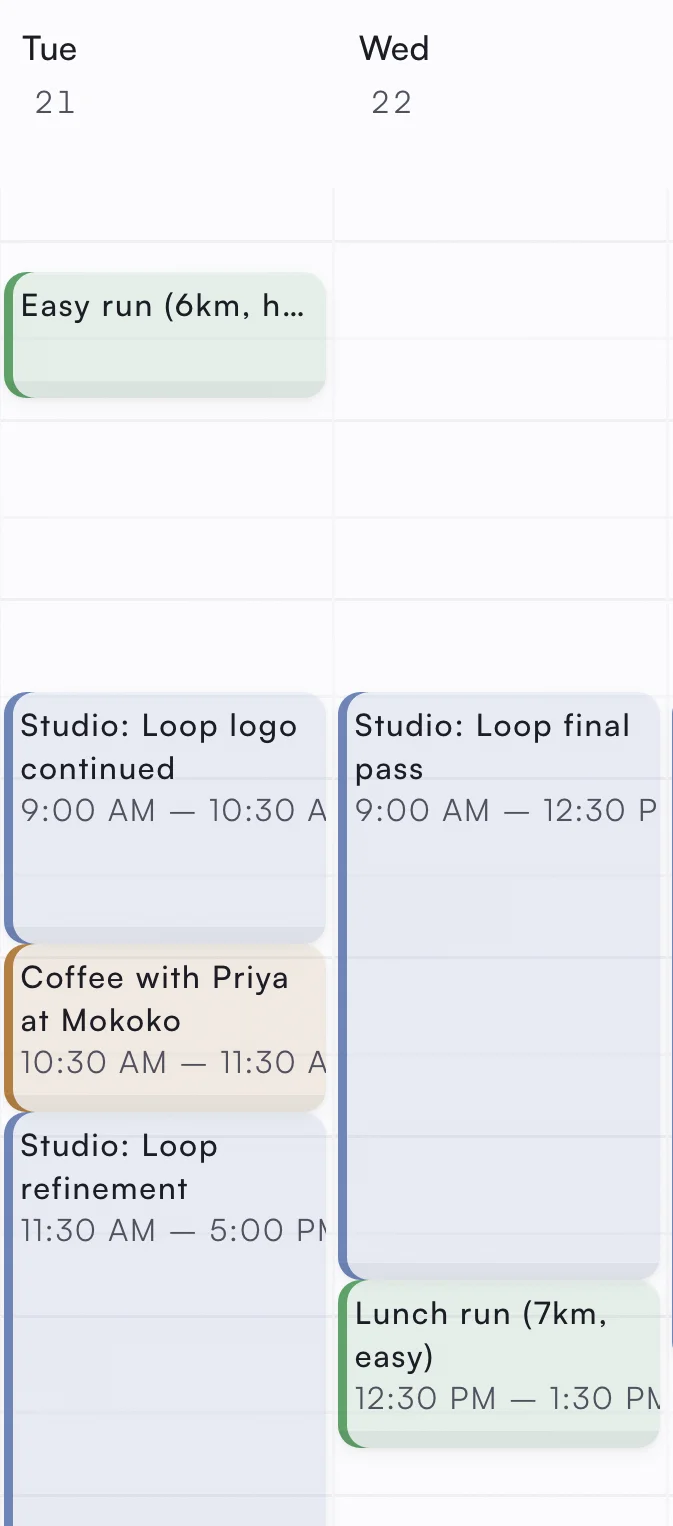
She starts with the wall: the studio blocks, the Wednesday send, the Friday drive. Then the gaps that survive contact: Tuesday before the studio (she is, genuinely, a morning person), lunchtimes, Friday afternoon once the deadline is gone, Saturday morning away. Then the sizing decision, which is where the shape of the week chooses the shape of the sessions. The runs that land on busy days are the easy ones: six gentle kilometres at 6:30 on Tuesday, and a seven-kilometre lunch run on deadline day itself, deliberately easy, because on a day like that the run is the pressure valve, not another demand. The hard work waits for the light days: a tempo run on Friday afternoon, after the send and before the drive, and the long run on Saturday morning from her mum's front door. Four sessions, none of them fighting the deadline, and nothing in the plan that requires a heroic version of her to show up.

The weeks you miss are part of the plan

Every training plan eventually meets a week that flattens it, so the difference between people who keep training and people who restart every January is mostly what they do next. The failure patterns are predictable enough to plan for:

  • The hero plan: five hard sessions written into an obviously heavy week. It dies by Wednesday and takes your confidence with it. Size down before the week starts, not after it breaks
  • The make-up trap: stacking missed sessions onto next week, which turns one bad week into two. Missed sessions expire. The plan resumes at the next scheduled one
  • The all-or-nothing restart: nothing until a fresh start on Monday, which becomes the Monday after. Keep a floor session instead: fifteen to twenty minutes that keeps the thread unbroken
  • The perfect-time hunt: waiting to become the 6am person you have never been. The best slot is not the optimal one. It is the one your actual week will let you keep
  • The borrowed week: carers, parents and shift workers often do not own their gaps at all. Anchor training to what does repeat (after the drop-off, between shifts) and shrink the unit. Twenty minutes counts

A training week drafted around the one you are having

This method is the shape asambl plans in, because health is one of the areas it drafts rather than the only thing it sees. It reads the same week you do: your calendar, your priorities, and the energy you have set day by day (full capacity, reduced, or recovery, the same Plan A, B and C you can run by hand; your call, and changeable midweek when things slide). Then it drafts protected training blocks into the gaps that actually exist, sized down on the weeks that are already heavy. It never adds load to a week you have marked as reduced, and it notices when a hard session has been stacked against the most demanding part of your week.

Every block is a proposal: you approve, move, resize or drop it before it lands on your calendar, and a session you log from your phone lands back in your training log on the desktop. What asambl will not do is coach. It plans and protects the time and keeps the record; the training inside the slot, and any question about what your body should be doing, stays with you and the people qualified to advise you. Your plans and training log stay on your own computer.

Two days of an asambl calendar week: an easy 6km run at 6:30 on Tuesday and an easy 7km lunch run on Wednesday, placed around long Studio: Loop work blocks.
Tuesday and Wednesday of the deadline week: two easy runs in the gaps the week actually has.

Sources

Cited for the two claims that carry this guide: that naming a time and place is what gets training done, and what a realistic weekly amount is. asambl's drafting behaviour was re-verified against the shipped app at publish.