Planning & review

How to make time for hobbies (when the week is full)

Enjoyment is never left over, because nothing is ever left over. How to give the things you actually love one or two real slots a week, protect them like commitments, and stop waiting for a free evening that is not coming.

Aleem O'BalogunBy Aleem O'Balogun|Updated |6 min read

The short answer

To make time for hobbies when the week is full, treat enjoyment as something you plan on purpose rather than what is left over, because nothing is ever left over. Give one or two things you genuinely enjoy a real slot in the week, protect that slot like any commitment, and keep it small enough to survive a bad week.

Steps

  1. 1

    Name the one or two things you actually enjoy

    Not the aspirational list: the real one. The test is simple: what makes you lose track of time, and what leaves you more restored than it found you? One or two answers is plenty. A week cannot protect seven hobbies, and it does not need to; it needs to reliably hold the ones that are actually yours.

  2. 2

    Give each one a real slot in the week

    A named evening or a named hour, placed when you plan the week, before the week fills. “Sometime this weekend” is not a slot; Thursday at seven is. The difference between a hobby you have and a hobby you had is almost always this step.

  3. 3

    Protect it like a commitment

    When something urgent wants Thursday at seven, make the collision conscious: what exactly is displacing this, and does it genuinely have to? Sometimes it does, and the slot moves rather than vanishes. Joy loses every tie by default; protecting it just means the tie gets played instead of forfeited.

  4. 4

    Keep a backlog so the slot never opens onto a blank

    Half of protected evenings die at the moment of “so... what shall I do?” Keep a running list of what you would enjoy next: the film, the album, the walk route, the half-started sketchbook. Walking into the slot with the next thing already chosen is the difference between an evening off and an evening lost.

Why hobbies are always the first thing to go

The reason is structural, and it is the same structure this library keeps finding: work arrives with scaffolding (deadlines, meetings, people waiting) and enjoyment arrives with none. Nobody chases you for the sketchbook. The band survives without you this week. No consequence lands tomorrow if the walk does not happen tonight. So in every collision between something with a deadline and something you love, the thing you love loses by default, quietly, week after week, and the person it belonged to files the loss under being busy.

The cost never announces itself, because each individual forfeit is small and reasonable. It compounds anyway. A year of deferred evenings is a hobby you used to have, and a decade of them is the version of the story where you cannot quite remember what you did for fun. None of it was decided; that is the point. The weeks that spend your enjoyment were never planned to, they just were never planned not to.

Protect enjoyment on purpose

The fix is blunt: enjoyment gets a slot, the slot gets protected, and both happen before the week fills rather than after. This is whole-life planning's one-pool argument applied to its least defended area: joy draws on the same hours as everything else, so if it is not placed deliberately it is spent by whatever was.

Two reframes make the slot feel less strange. First, scheduling joy is not regimenting it; it is the opposite. You are not planning the fun, you are planning the conditions for it: the protected evening is a fence, and inside the fence nothing is scheduled at all. Second, a slot on the calendar is not a demand, it is a default. Defaults are what survive tired decisions. The evening that exists on the calendar happens unless something displaces it; the evening that exists as an intention waits for energy you will not have at eight on a Thursday.

Small and regular beats rare and grand

The most common way people plan enjoyment is in grand units: the holiday, the someday project, the proper free weekend that keeps not arriving. Grand plans have their place, but as a strategy for joy they fail on frequency: fifty ordinary weeks pass unenjoyed while the one great fortnight carries the whole year's weight. The maths never works, and neither does the waiting.

The unit that works is embarrassingly small: forty-five minutes to an hour, once or twice a week, reliably. An hour of the guitar on Tuesdays outperforms the vague ambition of a music-filled life, because it exists. Small also survives: a protected hour bends around a heavy week (shorter, moved, gentler) where a grand plan just cancels. And small compounds in the direction you want; fifty sketch hours is a sketchbook, fifty deferred ones is a regret with a page count of zero.

The deadline week, with the joy left in

The same week this library keeps planning, on its fourth lens: the designer, the Wednesday client deadline, training through the week, away to family from Friday evening. The heaviest week of the month, and here is what it still held, because all of it was decided on Sunday in about two minutes.

The band rehearsal on Sunday afternoon, standing and protected, the one thing in the week that is entirely hers. A golden-hour walk on Tuesday evening, placed deliberately on deadline eve as a pressure valve rather than despite the pressure. And a sketch hour before Thursday's pub quiz, sitting in a gap the week already had. Three joys, none over an hour, none of them earned or deserved or squeezed in, all of them simply planned, the same way the deadline was. The week did not get lighter. It got lived in.

The ways protected time falls apart

The failure patterns are predictable, which makes them plannable:

  • The leftover-time plan: waiting for a free evening to emerge. It will not. Full lives do not produce leftovers, and a hobby waiting for spare time is a hobby ending. Place it or lose it
  • The grand-plans trap: saving enjoyment for the holiday and the someday project while the ordinary weeks pass unenjoyed. The year is made of the ordinary weeks
  • The guilt tax: treating joy as unearned until everything else is done. Everything else is never done. Rest and enjoyment are part of a working week, not a reward for finishing one
  • The blank-slot problem: protecting the evening, then spending it scrolling because nothing was queued. The backlog is the fix. Arrive with the next thing already chosen
  • The audit reflex: tracking the hobby into a job, with targets, streaks and output. If measuring it makes it feel like work, stop measuring it. The hobby's output is you, restored

A week with joy planned in, not left over

This is one of the areas asambl plans rather than an afterthought bolted on: joy is one of the six, so when it drafts your week, enjoyment is drafted alongside work and training, a protected slot proposed before the week fills, which you approve, move, or swap like any other block. On a heavy week the trimming falls on the demanding areas first; the small joys are the cheapest thing in the plan and the last thing worth cutting, and the draft treats them that way.

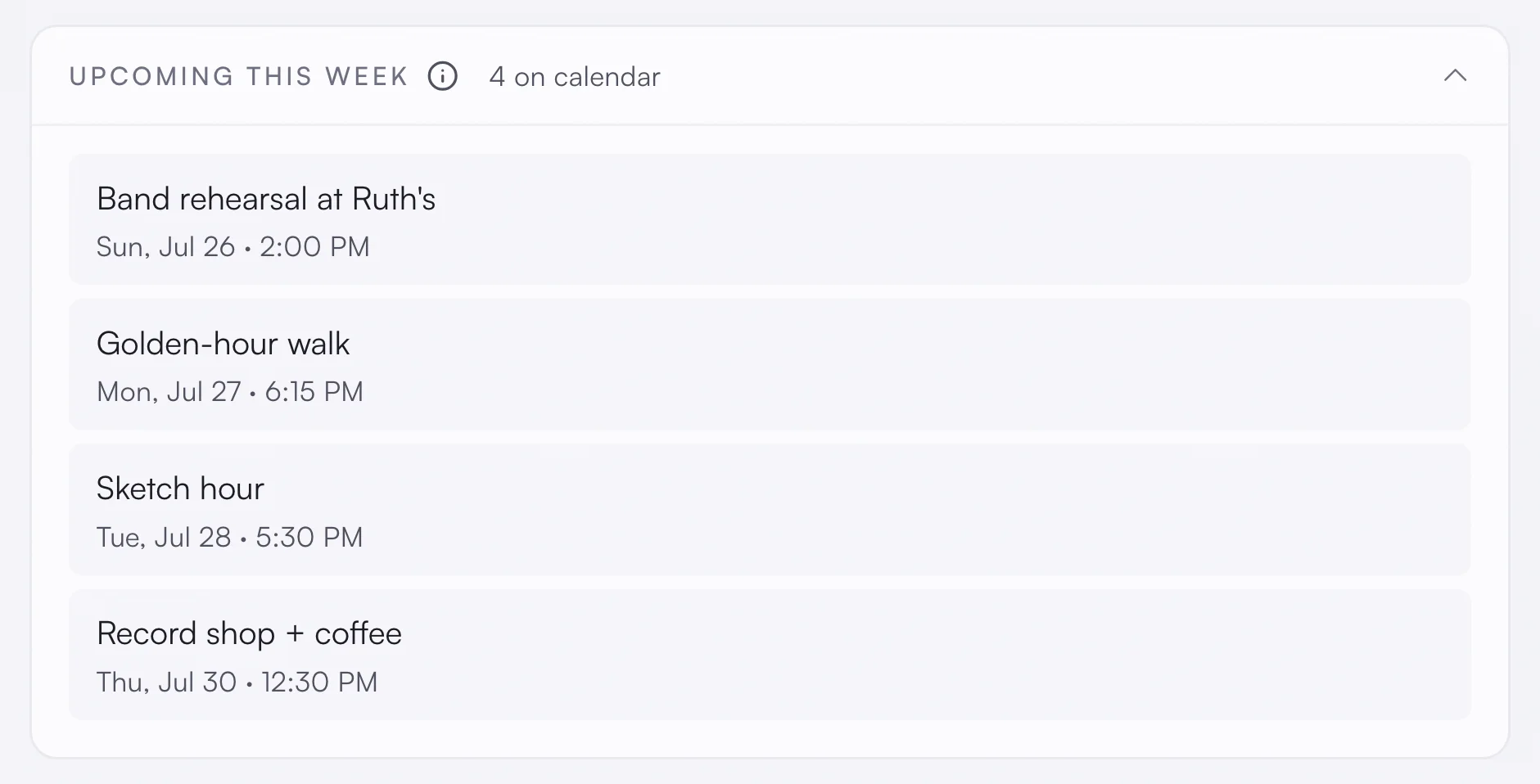
The backlog lives there too: your media library holds the films, shows, music, and podcasts you actually want to get to, with the things you return to marked as such, so a protected evening opens onto a shortlist instead of a scroll. And the week's joy blocks sit visibly in the area's upcoming view, which is a quiet kind of accountability: you can see, in one glance, whether next week contains anything you are looking forward to. If it does not, that is worth knowing on Sunday rather than discovering on Friday.

asambl's Joy area showing the Upcoming this week fold with four protected blocks: a band rehearsal on Sunday afternoon, a golden-hour walk on Monday evening, a sketch hour on Tuesday, and record shop plus coffee on Thursday lunchtime.
The week's joy, visible at a glance: protected before the week filled.