
Planning & review

How to plan meals for a busy week

Not a recipe project: a planning method. Decide the dinners before the week starts, match them to the shape of each evening, keep a short rotation you can cook without thinking, and stop negotiating with the takeaway at 6pm.

Aleem O'BalogunBy Aleem O'Balogun|Updated |6 min read

The short answer

To plan meals for a busy week, decide the few dinners in advance and match them to the shape of your week: the easiest meals on your latest nights, the proper cooking on the free one. You stop deciding what to eat at the moment you are tired and hungry, which is the moment the takeaway always wins.

Steps

  1. 1

    Decide the dinners before the week starts

    Five minutes, once, alongside planning the week: name the weeknight dinners in advance. Only dinners, only the nights you are actually home. The point is not culinary ambition; it is moving the decision from 6pm, when you are least equipped to make it, to a calm moment when you can see the whole week.

  2. 2

    Match each meal to the shape of its night

    Read the week first, then assign effort: the latest, heaviest nights get the ten-minute meals, the ordinary nights get your standards, and the one genuinely free evening gets the proper cook. A good meal plan is not a menu; it is effort placed where the week can afford it.

  3. 3

    Keep a rotation, not a recipe collection

    Write down the eight to ten meals you can cook without thinking and let the week draw from that list. Novelty is for the free evening, never for a Tuesday. A short rotation you actually cook beats a folder of saved recipes you scroll past while the pasta water boils.

  4. 4

    Shop once, against the plan

    The list falls straight out of the decided dinners plus your staples, so buy the week in one shop and stop topping up. Shopping without a plan is how you buy ingredients for the person you wish you were and bin them on Friday.

Why the 6pm decision always beats you

The weeknight dinner problem is not a cooking problem. It is a scheduling problem: the decision lands at the worst possible hour, when you are tired, hungry, and standing in front of options, and it lands every single day. Whatever the science of decision fatigue does or does not prove about willpower, the 6pm version is a matter of design: a decision deferred to your weakest moment will be made by your weakest self, and the takeaway wins not because it is better but because it is already decided.

The fix is the same move that fixes the rest of the week: make the decision once, in advance, at a calm altitude. A dinner decided on Sunday is not a better dinner than one decided at 6pm; it is just decided by a better decision-maker.
Plan meals around the week, not the other way round

Most meal planning fails because it starts from food: seven appealing dinners chosen in the abstract, assigned to days at random. Then Tuesday turns out to be the late night, the ambitious traybake meets a person who got home at eight, and the plan dies with a phone in its hand. Plan in the other direction. Read the shape of the week first, which nights are late, which are ordinary, which one is actually free, and let the shape choose the effort level. The food is the last decision, not the first.

The nightThe meal that survives it
Home late, or straight from trainingAssembly, ten minutes: eggs on toast, big-batch leftovers, the freezer's finest
An ordinary eveningThe 25-minute standards from your rotation
The one free eveningThe proper cook, doubled on purpose: tonight's dinner and a busy night's leftovers
Deadline day, or the heaviest dayDecided and effortless: leftovers by design, never a new recipe
Out, travelling, or awayNot your problem: cross it off and plan nothing
Effort placed where the week can afford it

A rotation beats recipes

You do not need recipes to plan meals; you need a list of the meals you already know how to make. Most households eat the same eight to ten dinners on loop anyway, and the only problem is that nobody has written the loop down, so every week re-derives it from scratch. Write it down once: the stir-fry, the traybake, the pasta you could make asleep, the soup, the things-on-toast. That list is the engine of every future weekly plan, and it kills the what-do-we-eat conversation at the source, because the question stops being “what could we possibly eat?” (infinite, exhausting) and becomes “which of our ten?” (trivial).

Novelty gets a budget, not a ban: one new thing at most in a normal week, cooked on the free evening where a failure is funny rather than a crisis. If the new thing earns it, it joins the rotation and something tired drops off. That is the whole system, and it fits on an index card.

The deadline week, fed by hand

The same week this library keeps planning, one lens further: a designer, studio days nine to five, the client deadline on Wednesday evening, training through the week, away to family from Friday night. Here is dinner, decided on Sunday in about four minutes.

Monday ends with a strength session, so it gets the prawn stir-fry: fifteen minutes, mostly staples, and deliberately cooked double. Tuesday has the early run and Spanish at half seven, so it gets assembly: eggs, sourdough, whatever the fridge is finishing. Wednesday is the deadline, and Wednesday cooks nothing: Monday's second portion was always for tonight, which means the hardest day of the week has a dinner that requires opening the fridge. Thursday is the pub quiz, so dinner is early and simple or it is at the pub, decided now rather than negotiated then. Friday is the drive to Cardiff: crossed off, nothing to plan. Five weeknights, two of them effectively zero-effort, one shop, no recipes consulted, and the takeaway never got its 6pm audience.

The weeks it falls apart are part of the plan

Meal plans die in predictable ways, and most of the deaths are designed in at the start:

  • The mega-prep fantasy: a three-hour Sunday batch-cooking session you dread, skip, and then abandon the whole plan with. The sustainable version is one doubled dinner. Cook once, eat twice, no Tupperware religion required
  • The aspirational shop: buying for the person you wish you were. That person cooks the salmon on Thursday. The person who exists orders pizza past it. Shop for the week you actually planned
  • The novelty trap: a new recipe on the worst night. New food belongs on the free evening, where getting it wrong is entertainment rather than collapse
  • The perfection reset: one unplanned takeaway read as the plan failing, so the plan gets abandoned. A takeaway is a substitution, not a verdict. Swap the night and carry on
  • The one-head plan: a meal plan that lives in one person's memory is that person's job forever. Write it where the household can see it, and the 5pm “what's for dinner?” text answers itself

A meal plan that has already seen your calendar

This method is exactly the shape asambl's nutrition planner works in, and the honest scoping is that it works on request: ask it to plan the week's meals and it drafts the menu and the full shopping list in one pass, shaped by what it can already see, the energy you have set for the week, the training sessions on your calendar, and the staples and standards you have told it you keep. The draft follows the same rules as this guide (your rotation first, effort matched to the week, the free evening for anything ambitious), and like every asambl draft it is a proposal: you swap nights, drop meals, and approve before anything lands.

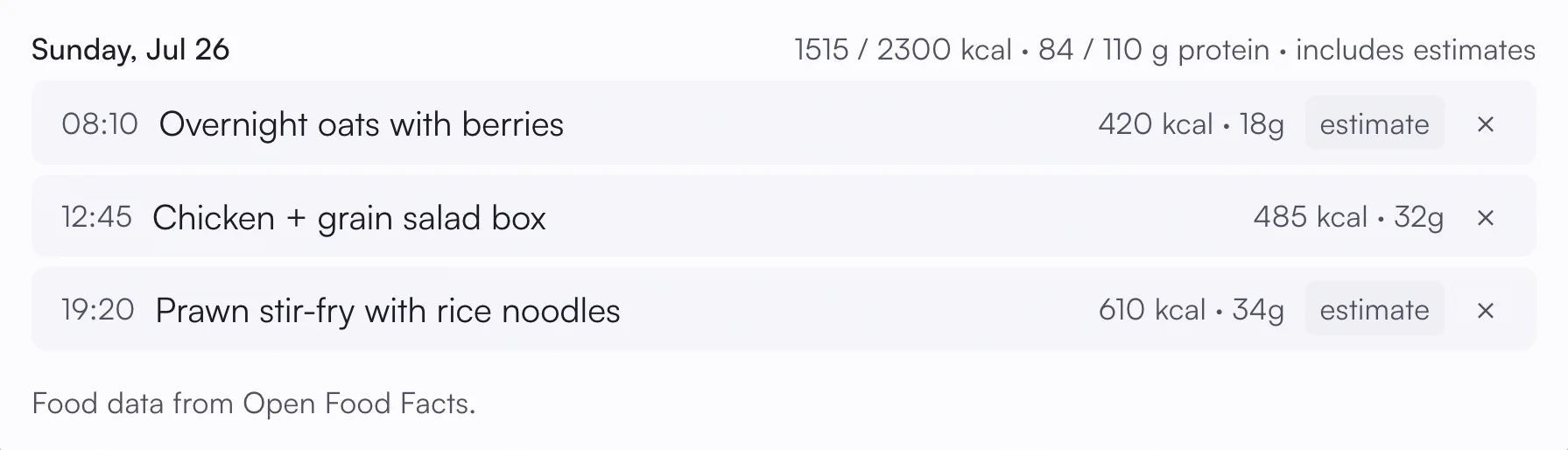
Then the week runs, and logging is the light half. Meals logged from your phone land straight in the diary; scanning a barcode logs that food with its exact figures from Open Food Facts, and anything estimated is labelled an estimate, always, so the day's numbers never pretend to a precision they do not have. Your calorie and protein targets sit beside the log, and the weekly target proposal moves in small steps computed from your own trend, staying quiet when nothing needs to change. What asambl will not do is prescribe: it plans meals and keeps an honest record, and it is a planner, not a diet, and none of it is health advice.

asambl's meal diary for one day: three logged meals totalling 1,515 of a 2,300 kcal target and 84 of 110g protein, with a barcode-logged lunch carrying exact figures, estimate badges on the estimated meals, and a Food data from Open Food Facts credit.
The day against your targets: exact where it can be, labelled honest where it cannot.