
Life admin & people

How to be a thoughtful gift-giver, all year

The people who always give the right thing are not intuitive; they are organised about noticing. How to catch the accidental wish list everyone narrates all year, keep it somewhere it survives, and let occasions reach you early enough to act well.

Aleem O'BalogunBy Aleem O'Balogun|Updated |6 min read

The short answer

Being a thoughtful gift-giver is not about spending more or being naturally intuitive; it is a small system. Notice what people mention across the year, keep it somewhere you will see it again, and let each occasion reach you with enough lead time to act, so the good gift is ready before the pressure starts.

Steps

  1. 1

    Listen for the accidental wish list

    People narrate what they want all year without meaning to: the mug they mourned when it chipped, the print they stopped in front of, the class they keep almost booking. None of it is hinting; it is just talk. The thoughtful giver's only real trick is treating that talk as information.

  2. 2

    Capture it in the moment, not at the occasion

    The sentence is alive for about thirty seconds, so the capture has to cost less than that: the thing, who said it, and any detail that matters (the colour, the size, the specific artist). December cannot remember April. Write it where you will genuinely look again, and always the same place.

  3. 3

    Give the occasion lead time

    A thoughtful gift usually needs weeks, not days: time to order the print, book the class, or make the thing. Decide how early you want occasions to reach you (three to four weeks does it for most) and set your reminders to that horizon. Never missing the date itself is its own discipline; this is about arriving early enough to act well.

  4. 4

    Close the loop after giving

    Afterwards, note what you gave and how it landed: loved, liked, politely received, or missed. Not scorekeeping; learning. Two or three honest notes per person and you stop re-guessing their taste from scratch, and the misses stop repeating. Next year starts already knowing what this year found out.

Thoughtful is a system, not a talent

Everyone knows one person who always gives the right thing, and the standard explanation is that they are just like that: intuitive, attentive, somehow born knowing. Watch them closely and a different picture appears. They are not remembering better than you; they are writing things down. They are not more inspired in December; they are working from notes made in April. What looks like a gift for gifts is almost always a memory system plus lead time, quietly maintained.

The reframe matters because talent cannot be copied and systems can. The gift that lands (the specific print, the course they kept circling, the replacement for the thing they loved and lost) is nearly always something the person said out loud months earlier, to someone who happened to keep it. Anyone can be that someone on purpose.
Capture the sentence while it is alive

The raw material of thoughtful giving arrives all year, unannounced, in the middle of other conversations. It cannot be summoned at the occasion; it can only be caught at the source. This is the notice loop's capture verb applied to people: the moment someone shows you what they want, get it out of your head and into the one place you keep such things, before the conversation moves on and takes the sentence with it.

Capture more than the object. Who said it, roughly when, and the detail that makes it right: the specific artist, the colour they pointed at, the size that fits. A vague note (something ceramics-ish?) forces December-you to guess again; a precise one hands over a decision already made. And keep one list per person rather than one heap for everyone, because occasions arrive one person at a time.

Lead time is where thoughtfulness lives

The difference between a thoughtful gift and a plausible one is rarely money; it is nearly always time. With three or four weeks in hand, the options are real: order the print and frame it, book the class for a date they can make, commission the thing, make the thing. With three days, the options are whatever ships fastest, and everyone involved can tell. The scramble is not a generosity failure; it is a lead-time failure.

So decide the horizon deliberately. For most occasions, being reached three to four weeks out is enough to act well; personalised and handmade things want longer. That is a different job from never missing the date itself, which has its own guide: the date discipline stops you being late, and the lead-time discipline stops you being generic. You want both.

The reaction is information too

The half of the system almost nobody runs: after the giving, notice what happened. Was it loved, merely liked, politely received, or quietly missed? One honest line, written down, and the next occasion starts from evidence instead of the same hopeful guesswork. The scarf that never got worn is not a small failure to forget; it is the single most useful fact you now hold about scarves and that person.

Over a couple of years this compounds into something that feels, from the outside, exactly like the intuition you were told other people were born with: you know what they love because you noticed what they loved. The system is the talent.

The ways gift-giving goes generic

The failure patterns are familiar, and each has a structural fix:

  • The December sprint: a year of noticing nothing, then a fortnight of guessing everything. Gifts chosen under deadline read as chosen under deadline. The fix lives in April, not December
  • The scattered notes: ideas in chats, screenshots, and the back of your head. Scatter is how the April sentence dies before December. One place, always the same one
  • The generic upgrade: solving uncertainty by spending more. A dearer candle is still a candle. Specific and modest beats expensive and interchangeable
  • The self-gift: buying what you would love and calling it thoughtful. The whole system exists because their taste is not yours. The notes protect you from your own
  • The missed reaction: giving, then never noticing what happened next. The gift that missed teaches you as much as the one that landed, if you keep it

Occasions that arrive early, with the notes beside them

In asambl, what you know about each person lives in one place: their standing likes and dislikes, sizes where they matter, the wish list you have been feeding all year, and the gift history with how each one landed (loved, liked, neutral, missed). It is the accidental wish list, kept: captured in thirty seconds at the source and waiting, organised by person, when an occasion comes into view.

And the occasion does the reaching. Birthdays and dates you care about surface in the week you plan with the lead time you choose, weeks out rather than days, so the deciding happens while ordering, booking and making are still on the table. Gifting here is not a tracker to maintain; it is one more way the week ahead gets planned with the important things already visible.

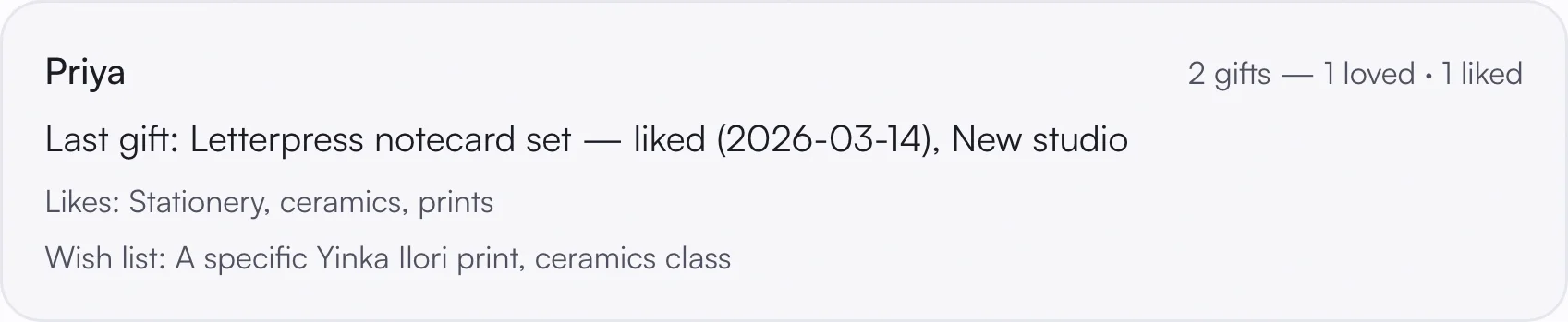
asambl's gift view for one person, Priya: two gifts with reactions, one loved and one liked, the last gift a letterpress notecard set marked liked, standing likes of stationery, ceramics and prints, and a wish list holding a specific Yinka Ilori print and a ceramics class.
One person's gift view: what landed before, what they love, and the wish list the year has been feeding.