
AI & control

AI journaling: what it's for, and why the writing should stay yours

Most AI journaling tools offer to write your entries for you, which removes the part that helps. Here is what journaling is actually for, and the honest role AI can play: reflecting with you, not for you.

By Aleem O'Balogun|Updated |8 min read

The short answer

AI journaling works best when the AI reflects with you, not when it writes for you. The act of writing is what helps you notice and process, so an AI that generates your entries removes the point. Use it to reflect back on what you wrote, keep your entries private, and let what you notice feed how you plan your week.

  1. 1

    Write it yourself first

    The value of journaling is the thinking you do while writing, so do not outsource the entry. Get your own words down, however rough. There is time for help afterwards, but not with the part that was doing the work.

  2. 2

    Journal more than your mood

    Feelings are worth writing, but so is your week, and what you read, watch, and listen to. A few honest lines on any of it, while it is fresh, is what you will actually look back on.

  3. 3

    Reflect, do not just record

    Once something is written, a good question can take you further than rereading it alone. This is the honest place for AI: to reflect back and ask, in a short back and forth, not to hand you a tidy conclusion.

  4. 4

    Keep it private by default

    Your entries should live on your own machine and stay there unless you choose otherwise. Reflect on an entry when you want to, one at a time, knowing exactly what that sends.

  5. 5

    Let it feed your week

    The point of noticing something is to act on it. Carry what you realise into how you plan the days ahead, so reflection changes something instead of sitting in a file you never reopen.

What AI journaling is actually for

Journaling helps for a plain reason: writing something down makes you notice it. Putting a week, a worry, or a film into words forces a small amount of honesty that scrolling past it never does. You do not need a system or a theory for this to work. You need to actually write, and then, now and again, to read back what you wrote and see what it tells you.

This is why the current wave of AI journaling tools is a little backwards. Many of them offer to write your entries for you, or to generate a tidy reflection from a few taps. It sounds helpful, and it quietly removes the one part that was doing the work. A journal an AI wrote is not your journal; it is a summary of prompts you did not think through. The value was never the finished text. It was the thinking you did to produce it.
The honest role for AI: reflect, do not author

If AI should not write your journal, what is it good for? The honest answer is reflection. Once you have written something, a good question, or a pattern pointed out, can take you further than staring at the page alone. The job is to reflect back and ask, not to hand you a conclusion. You still do the noticing; it just becomes easier to start.

This is how asambl approaches it. You write the entry. Then, if you want to go deeper, you can reflect on that entry, and asambl runs a short back and forth, a handful of turns, grounded in what you wrote, the entries you have linked to it, and the values you set. It never rewrites your words or files a conclusion for you. It asks, you answer, and what you realise stays yours. If an entry is too thin to reflect on yet, it tells you to write a little more first rather than inventing depth that is not there.

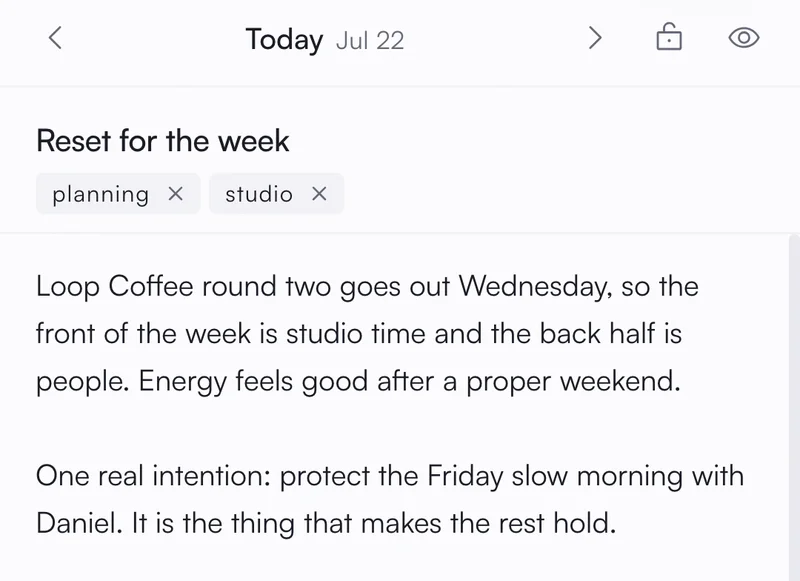
asambl's journal open on today's entry, titled Reset for the week and tagged planning and studio: a few honest lines you wrote about the shape of your week.
Your own words, tagged and dated

Journal your week, and what you read and watch

Most journaling advice quietly assumes you are writing about your feelings, and you can. But some of the most useful things to journal are not moods at all. What you read, watch, and listen to shapes you more than you notice, and most of it evaporates within a week of finishing. A few lines on a film while it is fresh, what it made you think, what you want to keep, is worth more than a star rating you will never look at again.

asambl has a place for this built in. Alongside the journal there is a media library for the films, books, shows, music, podcasts, and newsletters you want to get to or have loved. You can jot a few lines on any of them and reflect on that entry the same way you would a journal note. Over time it becomes a record of what actually landed, not just what you got through, and it feeds back into your weeks: the book you meant to finish, the idea you wanted to act on.

Keep your journal private

A journal is the most sensitive thing most people write, which makes the privacy question sharper here than almost anywhere. It is worth knowing, before you start, where your words go. Many AI journaling apps send every entry to a server the moment you write it, because that is how their AI features work. That is a real cost, and it is easy to miss until it matters.

asambl is built the other way round. Your journal entries start private and stay on your own computer as plain files; nothing is sent anywhere just because you wrote it. Reflecting on an entry is a choice you make one entry at a time, and when you make it, asambl tells you plainly what it is sending, that entry, anything you linked to it, and your values, to its managed AI, and nothing more. It is honest about the trade: reflection uses a cloud AI call you choose to trigger, and the rest of the time your journal is simply yours, on your machine.

Reflection that feeds your week

Journaling that stays in a journal is better than nothing, but it drifts if it never touches the rest of your life. The point of noticing something is to do something with it. This is where reflection and planning meet: the thing you realised on Sunday, that you are tired, that a project is slipping, that you keep meaning to call someone, is exactly what next week should be shaped around.

asambl is a private weekly planner for macOS and Windows, and journaling lives inside it on purpose, as the input to a better week rather than a separate diary you keep and forget. What you capture and reflect on becomes context asambl can draw on when it drafts your week, so the noticing does not just sit there. You still decide what makes the week; reflection just means you are deciding from what you actually learned, not from a blank page.