
Planning & review

How to set goals that actually stick

Most goals fail from weak setup, not weak willpower: they stay vague and never touch your week. Here is how to set goals specific enough, and close enough to your real life, to hold.

By Aleem O'Balogun|Updated |7 min read

The short answer

Goals stick when they are specific, tied to who you want to become, and given a place in your actual week. Vague goals like 'get fit' or 'read more' fail because they never turn into a concrete action at a set time. Make the goal specific enough to tick off, connect it to the person you are becoming, plan it into this week, then review what held and adjust.

  1. 1

    Start from a value, not a task

    Before you write a goal, name the part of life it belongs to and the kind of person you want to be in it. A goal that comes from who you are trying to become holds better than one you set because you think you should.

  2. 2

    Name the goal, then make it specific

    Turn a vague intention into something you could point at and call done or not done. 'Get fit' becomes a concrete weekly action; 'read more' becomes a page count or a set evening. Specific enough to tick off is the bar.

  3. 3

    Tie it to who you are becoming

    Phrase it as an identity, not a chore: 'I am someone who trains twice a week', not 'I should exercise more'. A goal attached to who you want to be survives the weeks you do not feel like it.

  4. 4

    Give it a home in this week

    A goal that never touches your calendar is one you drift from. Put it in the week you are actually planning, at a real time, around your fixed commitments, so it has to compete for space like everything else.

  5. 5

    Review and carry it forward

    At the end of the week, check what held and what did not, and why. Keep what worked, adjust what missed, and carry the goal into next week with that context instead of starting over.

Why goals don't stick

Most goals do not fail because you lack willpower. They fail because they were never set up to survive contact with a real week. A goal like 'get fit' or 'save money' or 'read more' is a direction, not a decision. It has no edge you can point at, no place in your calendar, and no tie to anything you actually care about, so the moment the week gets busy it quietly loses to whatever is concrete and due.

There is a reason this happens so reliably. Setting a goal well is the highest-friction part of planning. It asks you to slow down, be honest about what matters, and make something vague uncomfortably specific. That is real work, so most people skip it and jump straight to tasks and to-do lists, which feel productive. You end up with a busy week that is not tethered to anything you were actually trying to build.
Goals-first beats freestyling

There are two ways to run a week. You can freestyle it: react to whatever lands, clear the loudest tasks, and hope the important things get their turn. Or you can start from a few goals and let them decide what the week is for. The second is harder to begin and far better to live, because a week built from goals is tethered to who you are trying to become, not just to your inbox.

This is where most productivity tools quietly let you down. They are task-first by design, brilliant at capturing what you will do and silent on why. They will hold a thousand to-dos and never once ask whether any of them add up to a life you chose. That is not a flaw in any one app; it is the whole category optimising the easy, low-friction half of planning and skipping the hard, valuable half.

The move most people skip: make it specific

The highest-leverage thing you can do is turn a vague goal into one you could tick off. 'Get fit' is a wish. 'Two strength sessions a week, adding a little when the last set feels easy' is a goal: you can look at it on Sunday and say done or not done. Specific does not mean rigid, and it does not always mean a number. A creative goal might resist a metric, in which case reach for an observable behaviour instead, something you would clearly see yourself doing.

This is the part asambl helps with, because it is the part people avoid. When you set a goal, asambl's goal coach can propose a stronger, more specific version for you to accept, reword, or decline. It adds a done-or-not-done criterion and a real but reachable stretch, in your own words, and it will not force a number onto a goal that does not want one. If your goal is already sharp, it stays quiet rather than inventing advice. It proposes; you decide, and it never rewrites your words for you.

Vague vs specific

Turn a wish into a goal you can tick off

A vague goal is a direction with no edge, so a busy week always beats it. The fix is to make it specific enough to point at on Sunday and call done or not done. Same intention, made concrete.

  • Get fit

    Two strength sessions a week

    Done, or not, by Sunday

  • Read more

    Ten pages before bed

    Countable, most nights

  • Save money

    Move £200 across on payday

    One transfer, done or not

  • See friends more

    One proper catch-up a fortnight

    A date in the diary

  • Be more creative

    A sketch every Sunday morning

    No number, a behaviour you would see

Specific does not always mean a number. When a goal resists counting, reach for a behaviour you would plainly see yourself doing.

Give the goal a week to live in

A specific goal tied to your identity still fails if it never gets time. The last step is the one people skip most: put the goal into the actual week, at a real hour, around the commitments you already have. When a goal has to compete for a slot like everything else, you find out quickly whether you meant it, and you protect it before the week fills up.

asambl is a private weekly planner for macOS and Windows built around this loop. You set your goals and priorities, and it drafts a week across your chosen life areas, work, health, money, relationships, growth, and joy, sized to the time you actually have. You review the draft and approve it; nothing lands on your calendar until you accept it. At the end of the week it helps you see what held and carries the rest forward with context, so next week starts from reality rather than a blank page. AI is on by default and can be switched off, and your notes and plans stay on your own computer as portable files.

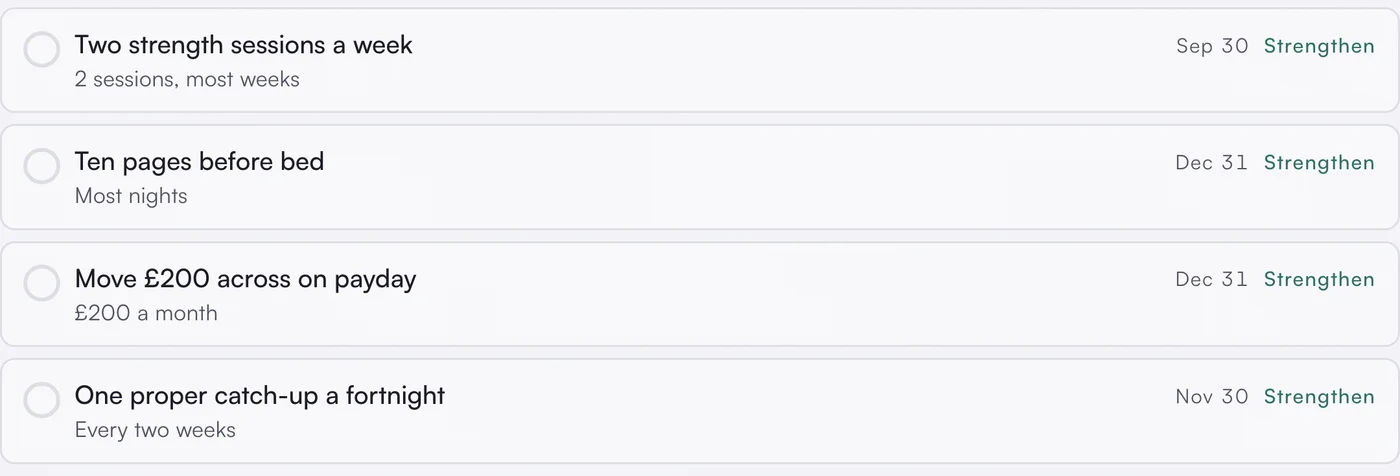
Four goals set in asambl, each specific and tickable with its own measure and deadline: two strength sessions a week, ten pages before bed, move £200 across on payday, and one proper catch-up a fortnight.
Goals specific enough to tick off, each with a measure and a date