
Planning & review

How to make time to read and keep learning

The free evening you are waiting for does not exist, and the twenty minutes you already have does. How to give reading a small protected slot in a full week, keep a queue so the next book is already chosen, and let consistency do what willpower has not.

Aleem O'BalogunBy Aleem O'Balogun|Updated |6 min read

The short answer

To make time to read, stop waiting for a free evening and give reading a small, regular, protected slot in the week you already have, even ten minutes. Keep a short queue of what you want to read next, so the slot never opens onto a decision. Consistency, not length, is what turns reading back into something you actually do.

Steps

  1. 1

    Shrink the unit until it fits

    The unit of reading is not the free evening; it is ten to twenty minutes. A chapter-a-sitting life is lovely, and a pages-a-day life actually happens. Pick the smallest slot you would genuinely keep on your worst weekday, and let that be the plan rather than the compromise.

  2. 2

    Give it a seam the week already has

    Small slots survive by attaching to something fixed: the commute, the lunch break, the twenty minutes before sleep. Name the seam when you plan the week so it is a decision made once, not renegotiated nightly against the sofa and the phone.

  3. 3

    Keep a queue so the next book is chosen

    Half of stalled reading lives die between books, in the gap where choosing lives. Keep a short queue of what you actually want to read next, capture recommendations the moment they happen, and finishing a book stops being an ending and becomes a handover.

  4. 4

    Protect it like the small thing it is

    Ten minutes is easy to delete precisely because it is ten minutes. When the week leans on the slot, make the collision conscious, the same way you would for any small thing you love: what exactly is taking this, and does it have to? Usually it is the feed, and it does not.

Why the free evening never arrives

Most people who say they want to read more are waiting for a certain kind of evening: unhurried, undemanding, long enough to sink into. That evening is rare in a full life, and when it does arrive, it rarely goes to the book. By eight o'clock the decision is being made by tiredness, and tiredness picks the path of least resistance, which is the phone. The desire to read is real. What is missing is not desire but a default: a time the book happens without being chosen each night from scratch.

So the fix is unglamorous: stop planning for the reader you are on holiday, and plan for the person you are on a wet Tuesday. That person has twenty minutes and a phone within reach. Give them a named slot, a book already chosen, and as little friction as possible, and they will read. Ask them to summon a free evening, and they will scroll.
Small and regular beats long and someday

The arithmetic deserves to be seen once, because it is the whole argument. Ten pages a day is around three and a half thousand pages a year: roughly a dozen ordinary books. A dozen books a year is a serious reading life, and it is built entirely out of slots too small to feel like reading time. Length is overrated; recurrence is not.

The same logic is how adults keep learning without a course, a curriculum, or an employer's permission. Twenty minutes of input a day, pointed at whatever you are genuinely curious about, outruns the occasional heroic weekend of self-improvement by miles, because it still exists in month three. Reading is the cheapest ongoing education there is; the only real tuition is a protected slot.

The queue is half the system

What stalls most reading lives is not the reading but the choosing. Between books there is a gap, and the gap asks a question: what next? If answering means browsing, remembering, and second-guessing, the gap stretches from a day into a month, and the slot quietly dies while it waits. A queue closes the gap: two or three books you actually want to read, already chosen by a calmer version of you, so the next one starts the same night the last one ends.

Feed the queue at the moment recommendations happen, because that moment does not come back. A friend mentions the book that undid them; you nod, mean it, and by Thursday it is gone. Capture it where you will see it again (a note, a list, wherever your system keeps such things) and the enthusiasm is banked instead of evaporated. A good queue is just other people's best recommendations, caught in the thirty seconds they were alive.

The ways reading time falls apart

The failure patterns are recognisable, which makes them fixable:

  • The guilt stack: a bedside tower of unread obligation. A tall stack does not create reading time, it creates avoidance. Keep the queue short and somewhere that is not staring at you
  • The phone in the gap: the slot exists and the feed takes it. The book has to be nearer than the phone. On the pillow, in the bag, first on the home screen
  • The wrong-book slog: grinding on through a book you stopped enjoying weeks ago. Abandoning it is not failing, it is unblocking. The queue means there is always a next
  • The chapter minimum: refusing to open the book for less than a proper session. Ten minutes reads more pages than zero minutes, every single time
  • The holiday reader: saving reading for the summer and the fortnight away. Fifty ordinary weeks pass unread while two carry the whole year

A reading list your week can actually see

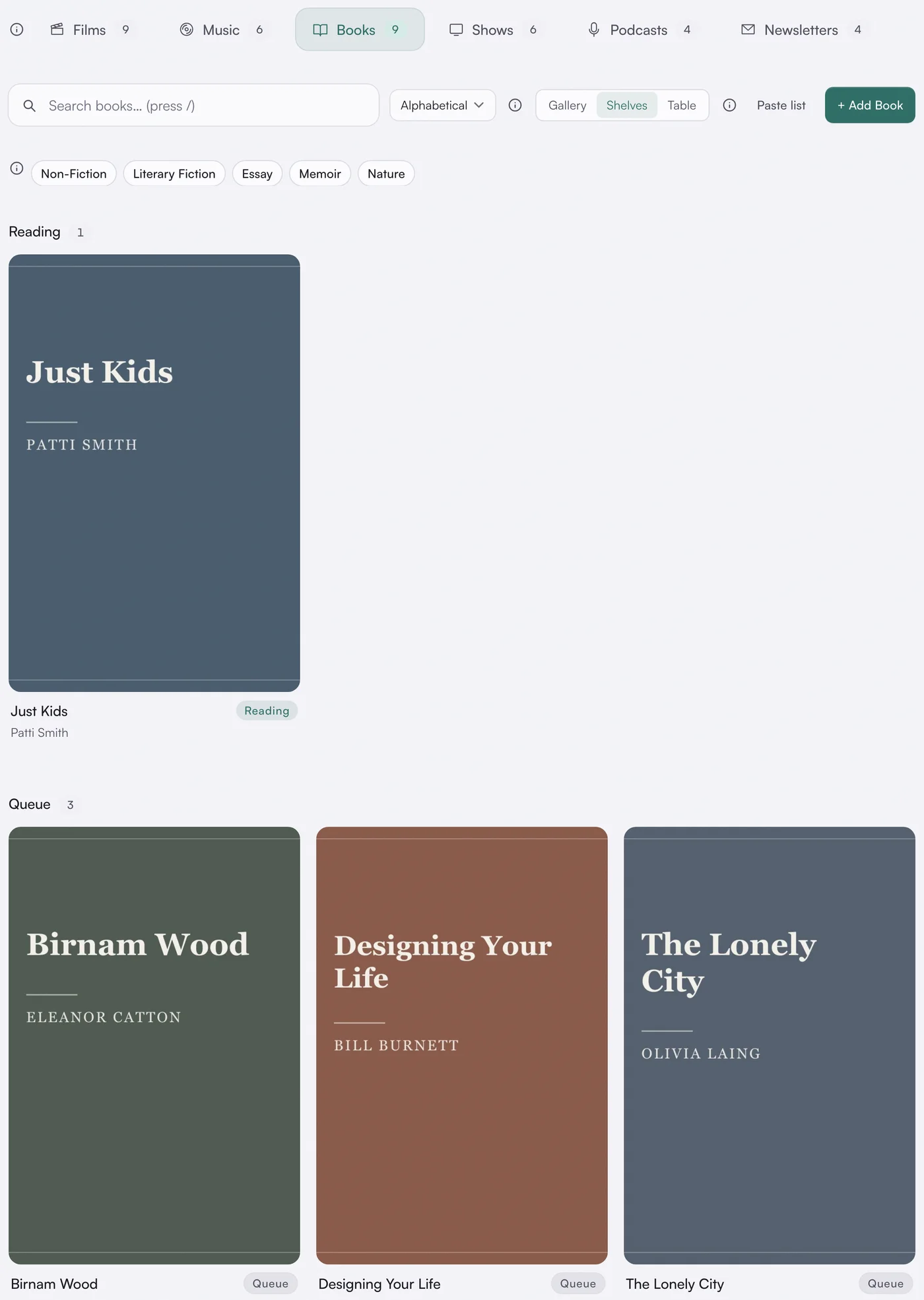
In asambl the backlog lives in the media library, one tab of it for books alongside films, music, shows, podcasts and newsletters. The books tab shelves what you are reading now, what is queued next and what you have finished, so the Thursday-night question (what next?) is answered by a shelf you built in calmer moments. Recommendations go in the moment they happen, and a whole list can be pasted in at once.

Because the backlog sits beside the plan rather than in a separate app, learning keeps a place in the week itself: growth is one of the areas asambl plans, so time to read and learn is drafted alongside work and training rather than left to compete with them after the fact. The queue holds what; the week holds when. Neither is asked to do the other's job.

asambl's media library on the Books tab in shelves view: a Reading shelf holding Just Kids by Patti Smith, and a Queue shelf holding Birnam Wood, Designing Your Life and The Lonely City, each shown as a plain typographic cover.
The backlog beside the plan: what you are reading now, and what is already chosen next.