
Focus & energy

How to build a weekly routine that holds

Not this week's plan: the scaffold under it. How to design the repeating layer of your week from anchors you already have, add the few priorities you want to recur, and keep it all small enough that the worst week of the month still fits inside it.

Aleem O'BalogunBy Aleem O'Balogun|Updated |7 min read

The short answer

A weekly routine is the repeatable scaffold of your week: the anchors that stay the same from week to week, so you are not redesigning your life from scratch every Monday. Build it once from your fixed commitments plus two or three recurring priorities, give each the same slot every week, keep the whole thing small enough to survive a bad week, and plan each specific week inside that rhythm.

Steps

  1. 1

    Collect the anchors you already have

    Start from what already repeats whether or not you plan it: standing meetings, the school run, training, the class you booked, the Sunday call home. You are not adding these, you are acknowledging them. Write them down with their days and times. They are the load-bearing walls the rest of the week hangs off.

  2. 2

    Add two or three recurring priorities

    Now the chosen layer: the things you want to happen every week that will not happen by accident. A money half-hour. A protected hour for something you love. The weekly planning session itself. Two or three is plenty, and every addition past that makes the whole structure likelier to fall.

  3. 3

    Give each one the same slot every week

    Sameness is the entire technology. An anchor that lives at Sunday six is a decision you never make again; a task that floats is a decision you remake weekly, forever. Put each anchor where it genuinely fits the shape of your week, not where an idealised week would put it, and then stop moving it.

  4. 4

    Write the steps down for the ritual ones

    For anchors that are really sequences (a Sunday reset, a money check-in), list the steps once, in order, with rough minutes against each. The list is what makes the slot start itself: you arrive and the first move is already decided. It also sizes the block honestly, so the routine claims the time it actually needs.

  5. 5

    Plan each week inside the rhythm

    The routine is the scaffold, never the week itself. Each week still gets planned properly: this week's priorities, this week's one-offs, this week's surprises, laid into the gaps the anchors leave. The routine's job is to make that planning quick, because half the week is already standing.

A routine is not this week's plan

The words get used interchangeably, and the blur costs people their system. A weekly routine is the repeating layer of the week: the anchors that sit in the same place every week, whatever that week turns out to hold. This week's plan is a different object entirely: the one-off arrangement of this particular week, with its particular deadline and houseguests and weather, laid out inside those anchors. Planning your week is a job you do every week. Building the routine is a design job you do once, then revisit a few times a year.

Even the ritual of planning belongs to the routine rather than the plan: the weekly reset is itself an anchor, usually somewhere around Sunday, and this week's plan is what comes out of it. Keep the two objects separate and each does its job well: the routine quietly holds, the plan honestly changes. Ask one object to do both jobs and you get the laminated ideal week that fits no week you have ever actually had.
What the blank Monday actually costs

Without a repeating layer, every week starts as an essay question. When does training go this week? When does money get looked at? When does the flat get dealt with? When do you even plan? None of these decisions is large, but they are all live, every week, all at once, and each has to be settled before the week can start working. That standing overhead has a name, and you feel it as the vague Sunday dread of a week that has to be invented before it can be lived.

The routine converts live questions into settled ones. Training is Tuesday and Thursday because it is always Tuesday and Thursday. Money gets twenty minutes on Sunday because it always does. What remains to decide is whatever is genuinely particular about this week, which is a shorter list than it feels: usually three to five priorities and a handful of one-offs. People with routines do not have emptier weeks; they have weeks where only the interesting decisions are still open.

Anchors first, ambitions second

Build from what already repeats, because it repeats whether you design around it or not: the standing meeting, the school run, the class with your name on the register, the Saturday market. This is found structure, not added structure, and most weeks hold more of it than their owner realises. Collect it honestly, with real days and real durations, and the true shape of your week appears, gaps and all.

Only then add the chosen layer, and add it sparingly. The ordering matters because the common failure runs the other way: start from ambitions, sketch an idealised week for a person with your name and someone else's discipline, and abandon the whole structure by the second Thursday. Anchors you already keep are proof of where your week can bear weight. Build on those, and the additions inherit their reliability.

Small enough to survive a bad week

The test of a weekly routine is not the calm week; it is the week with the deadline, the cold, and the visiting in-laws, all at once. Design for that week from the start. Three to six anchors plus two or three chosen priorities is a full-sized routine for a working adult, and anything much grander is decoration that works only in fair weather, which is to say it is not structure at all.

Sized like that, a bad week bends the routine without breaking it. An anchor can shrink (the forty-minute prep becomes fifteen) or slide within its day, and the crucial part is what happens next: nothing. No redesign, no catching up, no re-deciding. The slot simply stands again the following week, because a routine was never a record of your performance, only the place where the week keeps its load-bearing walls.

The deadline week: what never moved

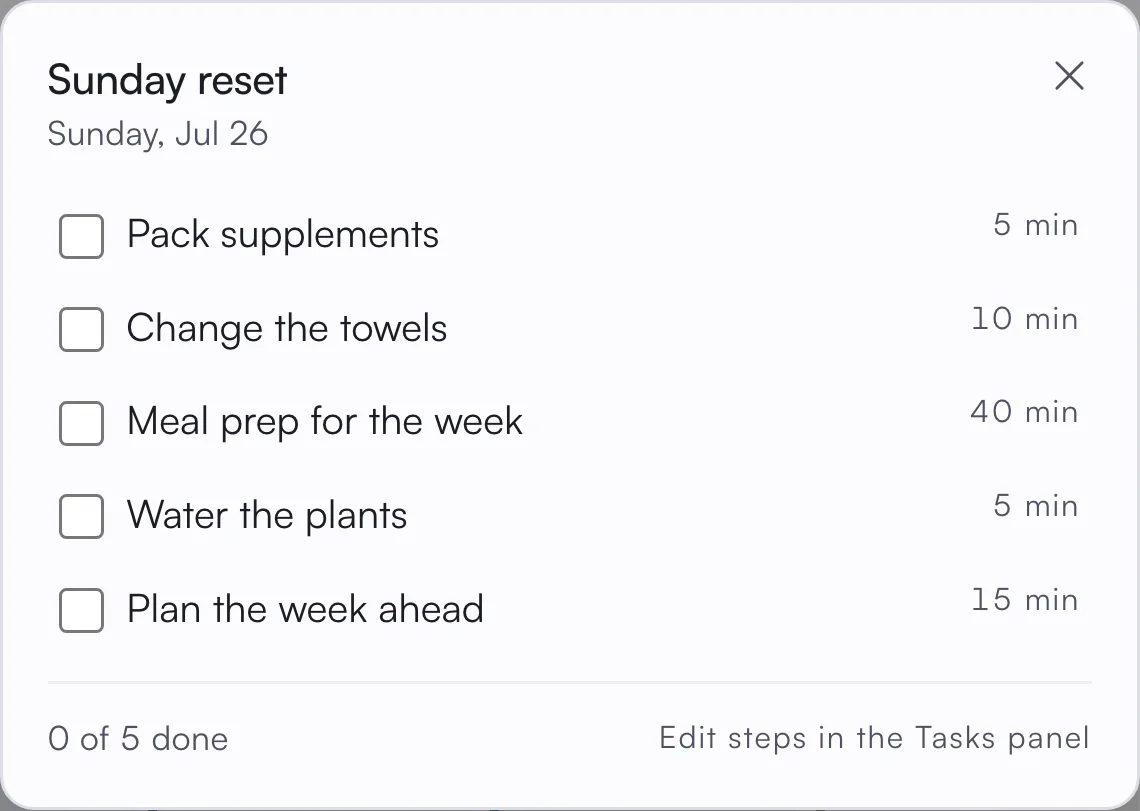
The same week this library keeps planning, on its fifth lens: the designer, studio days nine to five, the client deadline on Wednesday evening, training through the week, away to family from Friday evening. The runs, the meals, and the joys have each had their walkthrough. This lens is the quietest: what stayed the same. The Sunday reset ran at six, the same five steps as every other week: pack the supplements, change the towels, prep the meals, water the plants, plan the week ahead. Seventy-five minutes, unchanged. The band rehearsal held its Sunday-afternoon slot, and the Thursday quiz stayed put. The heaviest week of the month arrived to find the scaffold already standing.

The routine did not know it was a deadline week. Its planning step did. Inside the same fifteen minutes it holds every Sunday, the loop ran as it always does (review last week, notice what is coming, shape this one), and what came out was a week unlike any other that month: the doubled Monday dinner that fed deadline Wednesday, the easy runs placed on the heavy days with the hard ones waiting past the send, three small joys set like ballast. Identical scaffold, singular week. That is the division of labour, working.

The ways weekly routines fall apart

The failure patterns repeat, which at least makes them designable-against:

  • The aspirational build: anchors chosen for the person you intend to become. An anchor you have never once kept is a hope, not a wall. Prove a slot twice before you let anything lean on it
  • The copied template: someone else's morning-to-night scaffold adopted wholesale. Their anchors fit their fixed points, not yours. Steal shapes freely. The slots have to be yours
  • The full-grid routine: routinising every waking hour until no real week fits inside. If the routine is also the plan, there is no room left for the week you are actually in. Anchor a little and leave the rest open
  • The all-or-nothing read: one missed Sunday taken as proof the system failed. It is one missed occurrence. The slot stands again next week. That is the entire point of having one
  • The set-and-forget: a routine built once while life moves on without it. Jobs change, terms start, seasons flip the evenings. Re-fit the anchors every few months or the routine quietly becomes fiction

Routines in asambl: anchors that keep their own slot

In asambl the repeating layer is a first-class object rather than a discipline you maintain by hand. A routine is a short ordered list of steps with minutes against each, given a day, a time, and how often it recurs: daily, weekly, every two weeks, or monthly. Save it and it holds exactly one recurring block on the calendar, sized to the sum of its steps, standing in next week and every week after without ever being re-planned. The Sunday reset above is one: five steps, seventy-five minutes, Sundays at six.

Click the block in any particular week and its checklist opens for that occurrence: tick the steps off as they happen, and when the last one goes the block itself reads as done. The ticks belong to that week alone, and next week's block arrives fresh, because a routine is a scaffold, not a score. When the week gets planned, routine blocks are treated like any other fixed commitment: the draft is laid into the gaps they leave, which is exactly what an anchor is for.

asambl's routine checklist for a Sunday reset: five unticked steps with minutes against each (pack supplements 5, change the towels 10, meal prep for the week 40, water the plants 5, plan the week ahead 15) and a footer reading 0 of 5 done.
One routine, one calendar block that recurs weekly: each occurrence opens its own checklist, starting fresh.